OVERVIEW

Thank you so much for taking time to look at our blog! We are a group of medical students who are passionate about training in underserved areas. This January and February, we are in Peru, Uganda, India, and Costa Rica internationally as well as locally in Flint and Lansing completing volunteer service, rotating in hospitals and clinics, and learning about international medicine and local underserved health care. We appreciate any time you take to read our reflections and any donations you might offer.

Please click the “Donate” link on the side for more details on how to give directly to these communities.


Monday, January 30

Genesee Free Clinic

        Latinos United came into existence during the Flint water crisis because all the materials regarding the crisis were in English, so the six major Latino organizations in Flint came together to distribute information to the Latino population. Myself, residents, and other medical students have been working with Latinos United for Flint since last September. Our original plan was the start health talks and health fairs for this population to raise awareness about diseases that Latinos are more susceptible to. We began this way but soon found out that there was a large subset of undocumented immigrants within this Latino population, meaning they had no access to health care. Through a team of highly committed and motivated individuals the Genesee Free Clinic wrote for and received a grant for a number free visits specifically for undocumented immigrants living within Genesee County. We have been going to events hosted by Latinos United and explaining that these undocumented individuals can receive care without fear of being exposed.  We started scheduling visits, but to our disappointment every single one ended up no showing.
            Now that I have been working at the free clinic we have actually had some of these visits used! I hope that the individuals that have been seen at the clinic will tell others that it is a safe program, simply there for their health care not for any ulterior motive. However, it is understandable this fear of being found out given the current environment in our country. Decisions for this group are often made out of fear of being exposed, which means that healthcare is often sacrificed. The programs in place to aid this population need to continue to reach out more than ever and assure them that there are resources, safe havens, and remind this group that they are not lesser than anyone else.

            I’m very proud of the work that Latinos United is doing, and I am honored to be a part of this group. While these office visits won’t solve the larger issue this country is currently experiencing, I do believe if utilized they could make an impact on the Flint population of undocumented immigrants. I hope that with a continued presence in Latinos United and repeated reminders of the grant that we can get more visits, which will hopefully equate to improved health outcomes for this group.     

Friday, January 27

Fighting Alcohol and Drug Addiction Together

The use and addiction of heroin, alcohol, opioids and other drugs are on a rise in the United States.  Specifically in Flint, Michigan there have been a large amount of addiction reported, as well as mortality from overdose.  Stopping any kind of addiction is no easy feat because the brain literally adjusts to the euphoria and makes your body crave the reward over and over again.  There are programs set in place for people who are ready to quit the majority of addictions that are known.  Programs such as Alcohol Anonymous for Alcoholics, long-term residential treatment, individualized drug counseling, 12 step programs and other self help groups.  These programs have all shown to be helpful with the aid of medical management for withdrawal symptoms, spiritual guidance and strong will from the individual.

In Flint, Michigan there is a unique approach to helping former and current addicts start and complete a road of recovery at the Genesee Community Health Center.  The Genesee Community Health Center is one of only two Federally Qualified Health Centers in Flint.  Their mission is to provide high quality healthcare services and programs in an integrated, patient-centered environment with a priority focus on homeless and public housing residents.  They offer a multitude of services from preventive health screenings, well-child visits and physicals to chronic disease management and mental health and substance abuse services.  They always leave room for walk-ins everyday and are right down the street from Hurley Hospital in case of emergencies.  They have a mobile clinic and do community outreach at a local mission every week.

I have the pleasure of working with the Genesee Community Health Center and my mission is to learn as much as possible about the clinic, how it functions and of course see patients.  The GCHC has medical management such as suboxone and vivitrol and comfort medications as part of their substance abuse services.  Their approach to the counseling and psychosocial support that is necessary for a successful recovery program is what I have found to be one of the most unique I have encountered.  They have staff who are “Recovery Leaders” who have all at some time in their lives had an addiction to a drug or substance and have chosen to give back by helping others on their road to quitting their addiction. As a recovery leader you not only show support, but you offer a ride to a recovery meeting, give advice, take clients for coffee, support the family members of the person going through the addiction, whatever is necessary to really reach out and help that person get through this hard time and successfully start or continue recovery.  During an open conversation with some of the recovery leaders, I had the honor of hearing their background stories and I learned that they love what they do. They come to work everyday with a full heart, ready to help and also feel that this helps them continue their road to recovery because they can lean on each other when they’re having a bad day.  One recovery leader mentioned that she actively seeks patients and goes into “drug homes” and “sketchy neighborhoods” because she is so passionate about stopping the cycle of addiction and showing that help is there if you need it.


There are possibly other substance abuse programs with a similar approach or maybe the same approach that I have not encountered. I have encountered this approach and I feel I would be doing a disservice if I didn’t share what they are doing in Flint to make a difference in fighting addiction.


Thursday, January 26

The Free Clinics


           If you look at the Detroit Metro area you will find a plethora of free health clinics. At first glance this seems incredible. In a place where the residents have lost so much, and lived in poverty for so long, it is inspiring to see so many clinics set up to provide at least basic healthcare for the residents of metro Detroit. However, the closer I looked the more I began to understand that an overabundance of free clinics might illustrate larger issues.
Firstly, if there are a large number of free clinics that means that we aren’t providing, or able to provide adequate healthcare (in the current system) to a large number of people that need it. There are a significant amount of social justice issues that explain this prevailing problem, which I will not delve into in this particular space. Secondly, I found another quite significant issue.  While it is beneficial if you have strategically placed free clinics to serve a population and thus eliminate the problem of a lack of transportation limiting access to healthcare, it can be counterproductive to have a random distribution of free clinics. I don’t doubt that the people who build free clinics do so with the best intentions, but I think that sometimes there is a lack of collaboration with already existing clinics. Those who start new clinics often do so, because of a perceived need that they hope to uniquely address. I argue that rather than continuously starting anew, we should invest in the already existing infrastructure. We should pool our resources and create phenomenal care in strategically placed locations.
The Gary Burnstein Clinic in Pontiac, MI exemplifies this idea. I was working there last week. It was 6 pm and we were beginning to see patients for the night. There was an excited buzz around the clinic that evening, because for the first time in a long time we were going to have a cardiologist seeing patients in the clinic. Not only that, but we also had a pulmonologist there, and we were beginning to do sleep studies on patients. It was especially thrilling because Gary Burnstein who started the clinic, in what was basically a closet, was a cardiologist himself. It is part of what led to this particular cardiologist to seek out the clinic and donate his time and expertise to care for those who needed it, but had no means to pay for it. This clinic is an example of how we should be using our resources. If we can create very strategically placed clinics where patients have access to every specialty then I believe we can improve patient care.
The clinic is an inspiring place, filled with altruistic volunteers that are trying to do a little extra good in this world. Yet, it must run to the best of its ability. This particular clinic fires on all cylinders in large part thanks to the executive director and his dedicated staff. They are constantly trying to pool resources so that people have the opportunity to come to the clinic for all of their healthcare needs. As the resources expand at Gary Burnstein I feel that the care the patients receive will continue to improve and hopefully their health will do so as well.

In closing, I think that the people who need care would better be served if free clinics spoke and collaborated a little bit more. It is similar to the problem that exists with electronic medical records in this country, where we as healthcare consumers would be better served if EMRs communicated with one another. We know the value of communication, but sometimes we falter, whether it is because we physically don’t have the means, we can’t find the time, or we are simply don’t know how to do it effectively.

Sunday, February 28

Alcoholism & Cloud Forests


Alcoholism...

Part of our project here in Costa Rica, which was mentioned in a previous post was to develop a curriculum for the "charlas" and talks that the clinic will discuss with the community as a part of their health education outreach. We dedicated the month of February to Addictions and Vices. This past Wednesday, we went to the local soup kitchen to talk to the women about Alcoholism and the effects of binge drinking. The group is SUPER interactive so we try to come up with fun ways to teach them important information. 
This week we played "Spin the Bottle" in Spanish known as "Gire la Botella" with questions and facts related to alcohol use and abuse. This brings me to one major learning point that I realized this week: it is hard and almost impossible to teach or explain to a person or group of people that they cannot or must not do  a certain behavior. We were reminded by many of the people we work with that these women come from families where drinking alcohol or smoking is just what they do. What is important is that we remember to focus our efforts on moderation and reminders of the affects instead of preaching "Do Not Do ___" or "You must completely quit___". 


The rules were simple: Each person had a chance to spin the bottle and the color they landed on would correspond to a pre-written question or true-or-false statement written on that color of colored paper. 

As many of our charlas go, questions sparked discussion and the ladies delved into stories of their past, questions about family members, or would share statements to just relay that they understand alcoholism and the effects of binge drinking. 

One of the ladies sharing a personal story about a family member who struggles with alcoholism and how she dealt and continues to deal with it. 


More of the ladies conversing. Often times children of the women are around for the discussion and enjoy participating and learning about the important topics, no matter the sometimes sensitive nature of the conversations surrounding such topics. 


Andrea reading off one of the "Cierto o falso?" True/False questions during the game.


We ended our session doing some yoga with one of the volunteers Claire! 

We measure the level of success of our charlas by the level of participation. We had almost every woman involved in discussion by sharing stories or even attempting to answer the trivia questions. We like to think that the interactive nature of the activities we bring fosters this kind of environment. The ladies exhibited more understanding of the effects of alcohol use on your mind and body and their level of excitement to participate makes us feel that this was a successful charla! 


... & Cloud Forests

That weekend, the #treschicasinrica went to explore The Monteverde Cloud Forest located in  the Cordillera de Tilarán (mountain range) within the Puntarenas and Alajuela provinces. The reserve consists of more than 26,000 acres of cloud forest.  This  natural attraction has very high biodiversity with the most orchid species in one place as well as hundreds of different types of mammals, birds, reptiles, amphibians, and insects. 


The reserve has several trails and the trails connect in certain points. Some  trails are longer  or more difficult than others and may feature bridges, waterfalls, a different type of path that involves more intense hiking. The weather was constantly changing- there would be drizzle or rain one moment and the next moment we would see the sun breaking through an opening in the trees. 


Map of the Reserve


The location of the forest being at such a high altitude (4,662 ft above sea level to be exact) allows it to be high enough to have clouds and moisture-filled fog permeating throughout the forest at all times. We learned that this helps nourish the ecosystem that live within the forest and sustain all life in it. 

Costa Ricans pride themselves on living in a country that puts so much money, energy, and time into preserving aspects of the country's natural beautiful. The Monteverde Cloud Forest Reserve is looked at largely as a tourist attraction, but little is done to alter the reserve and there are many native Costa Ricans who come to visit the forest, in addition to the medley of Europeans, Americans, and South Americans of course. 

Working at the clinic during the week and doing talks with the ladies at the soup kitchen gives us the chance to learn directly from the people of here on a close and personal basis. We get snippets of  the way that so many people's lives work on a day-to-day basis and how they handle things that are thrown at them and can add confusion and complexity to their daily routine and especially their health. The weekends are nice for us to explore the country when we can, and reflect on the stories and situations we have been involved in that week. We get to learn more about Costa Rica and the history people that reside in this country but we also get to see the dynamics of Costa Rican life and culture in a non-acute setting. 

We hope you enjoyed this blog post!

Pura Vida,

#TresChicasInRica

Sunday, February 14

A brief(ish) comment on the ethics of the medical trainee at home and abroad


           There’s a natural conflict inherent to medical training that often goes unspoken.  On the one hand, patients typically receive the best care (and least harm) when treated by the most experienced and seasoned clinicians.  On the other hand, it’s impossible to create seasoned clinicians without having novices gain experience treating real patients.  Medical education has created certain ways in which novices can gain experience without putting patients at risk: case-based book learning, a well-regimented hierarchy of supervision for trainees, and high-fidelity simulations, to name a few.  Nevertheless, we have yet to figure how to completely protect patients from the learning curve of trainees and other less-experienced doctors.  It’s a puzzling and tremendously challenging Catch-22 in medical education.
           I’ve reflected on this much during my training at home, and have continued to do so now in a Global Health context.  In the U.S., I work hard to maintain a subtle balance in my training: on the one hand proactively challenging myself to take on new responsibilities while on the other hand knowing when something is so far beyond my level of expertise that it would ultimately compromise patient care.  Of course, much of the decisions about what is or is not appropriate for a medical student of a certain level of training to do comes from medical educators.  Some of these boundaries are designed directly into medical school curriculums, but in my experience much of the decision behind “do I feel comfortable with medical student X doing patient care task Y” falls on the individual level of trust built between a student and a preceptor.  If the student shows they are well-read, comfortable, professional, and capable, then they get to take on patient care responsibilities possibly above the level of some peers.  If they exhibit a critical lack of knowledge, poor clinical skills, unprofessional behavior, immaturity, or significant discomfort with basic patient care tasks, then they stay working on the basic patient care tasks and possibly get closer supervision to boot.  For me, I’ve consistently felt that I learn the most when I’m challenged with the most amount of patient care responsibility, within reason.
         
           Abroad in the Global Health context, however, things are a bit different.  Not since my first clerkship a year and a half ago have I so often been a simple observer rather than an active participant in patient care and medical decision making.  However this is the spot I often find myself now in the emergency departments here in Peru.  I am still learning a lot, but not in the same hands-on taking care of my own patients sort of way I’ve become accustomed to.  I’ve thought about it a lot and I’m not certain that pushing for more than this would be appropriate, for a couple of reasons.  First, the patient care resources here are both vastly different and generally less abundant than in the U.S.  For this reason, applying my knowledge and experience of American medicine to medical decision making in Peruvian patients will, while for the most part be OK, create at times an unacceptably high risk of making serious errors due to a lack of understanding of Peru’s medical resources.  Secondly, while I speak Spanish well enough to get by in the majority of both conversational and medical interactions, I am still far from the level of a native speaker.  As such, taking histories without supervision and presenting patients to non-English speakers does have a risk that subtle but critical details will be lost in translation.  

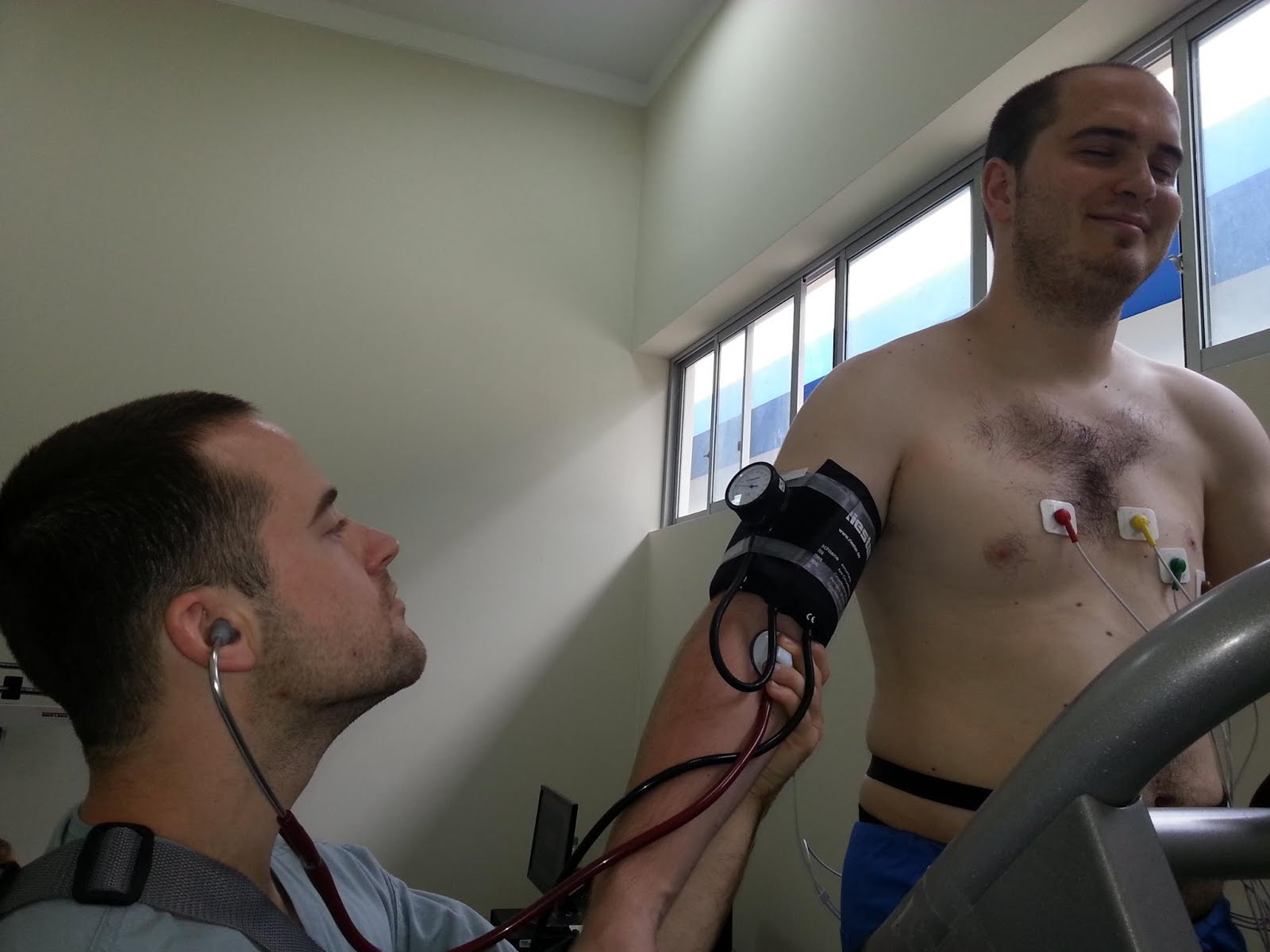
Props to Joe: taking a BP on somebody running on a treadmill is tough.  Oh, and yeah my stress test was normal.
          So what has this meant for my learning here in Peru?  For the time here to be a valuable addition to my clinical training, I needed to be challenged in a way similar to domestic clerkships that test my clinical skills and clinical knowledge.  Despite taking a far more conservative than normal approach to clinical training here in Peru, I still think these learning goals have satisfactorily been met.  On the one hand, a large part of my interest in doing a Global Health experience was the possibility to greatly improve my clinical communication abilities with Spanish-speaking patients.  This certainly has been the case, as working directly alongside doctors and patients who don’t speak a word of English has forced me to get better very quickly.  Additionally, I’ve learned a lot from analysing both the direct medical decision making as well as the greater healthcare system as a whole in Peru and comparing it to what I know at home.  Both the similarities and differences are illuminating, and I think I’m gaining some great perspective with every comparison of what seems to work and what doesn’t.  And finally, it’s been interesting to see many presentations of diseases that are rare but important in the U.S., like TB or stomach cancer.  So, though I might not be putting in central lines or evaluating multiple critical patients on my own before staffing them with a preceptor, I feel that the clinical experience has been well worth it and a strong addition to my final year before residency.

Saturday, February 13

Health Issues in Peru

After volunteering with different projects in Peru for 5 weeks and having the chance to work with doctors and nurses from La Merced and Huancayo, we have learned much about the challenges facing the Peruvian health system.  While our focus is more on teaching children about healthy habits and addressing nutrition issues, it has been very eye-opening to sit down with local doctors and discuss the issues they are facing and the different and similar issues that we face in the US.

Health Insurance - Most people in Peru are covered by public health insurance called SIS (Seguro Integral de Salud) that is available to all citizens.  It covers most of the basic things that health insurances cover, but there are some failings.  One major charge to patients is payment for supplies.  This may include basic things, like nutritional drinks (e.g., Ensure) for patients who can't eat solid foods and water to mix medications.  Families must go out and buy these supplies with their own money and give them to the hospital so they can be used to treat patients.  In rural areas, there is also the issue of transportation to larger hospitals.  One boy came into the health post after his hand was crushed by a machine in an iron-works facility.  One finger clearly had a fractured bone but the adult who brought him in insisted he be treated at the health post since the hospital was 30 minutes away and would cost about S/. 5 (quite a lot when weekly wages can be as low as S/. 30).  So the doctor did her best in a situation where there were no capabilities of getting an x-ray nor an available surgeon to treat the wound.  All she could do was suture the wound, place a splint, and ask him again to go to a hospital to get properly treated.

Health Posts - Most communities have a small health post which is similar to a community clinic in the US.  People come for routine well-child checks and urgent care type visits.  These health posts, however, are extremely under-resourced.  At one that I worked at, gloves were rationed to the point that they were only allowed for births and suturing and left over sutures were sterilized and re-used.  These health posts are also typically run by a recent medical school graduate.  All medical students are required to do a rural medicine year after graduating medical school and prior to starting residency.  These doctors are fresh out of medical school and are not overseen by a senior physician and are expected to handle the vast majority of cases that come through the door on their own.


Pharmacies - While most people in the US tend to head for an urgent care center or an emergency room when a cold or a pain comes up, the people of Peru often head first to a pharmacy.  Pharmacies are on ever corner and some offer medical consults for S/. 10 (or about $3 USD).  Often times, patients will come away with some pill which they take once and hope it works.  Patients rarely know what it is that they have taken and even when it is the right medication, they can only receive one days worth without a doctor's prescription, a dangerous thing when it comes to antibiotics and even more so when it is happening in a country where TB is prevalent and there are many cases of MDR and XDR-TB.

Traditional Healers - Traditional medicine is a very important aspect of Peruvian culture.  Traditional medicine practitioners are called curanderos.  One of their ways of detecting disease in people is by passing a guinea pig over the person's body and then performing a necropsy on the guinea pig to identify the disease.  There are also hueseros who are similar to chiropractors who focus on fixing pain through manipulating the bones.  Matronas are untrained midwives who help women deliver their babies at home, a very common practice.  Sometimes, these matronas provide women with an herbal drink to induce contractions, but these can sometimes induce placental rupture due to the strong contractions which tends to result in the death of the baby.

Obstetrics - Obstetricians face many challenges in Peru.  For one, pre-eclampsia and eclampsia are very common problems and deaths of pregnant women is a major public health concern.  For the obstetrician, however, there is added pressure as the death of the mother under their care can result in criminal prosecution.  Unsurprisingly, there are now very few obstetricians and women are having difficulty finding one when they need it.  Many women prefer to have their children at home, particularly in rural communities.  When they do, they often cut the umbilical cord using a rock or a roof shingle.  Abortions are illegal under Peruvian law and many women are at risk due to going to illegal abortion centers.  While contraceptive usage is fairly high nationally, the machismo culture sometimes forces women to say no to contraceptives since men feel that if their partner is using contraceptives, they would be more likely to cheat.

Pediatrics - Most of our focus has been with working with kids and being an aspiring Pediatrician, I had many opportunities to work with the Pediatric wards.  Many kids that we saw in the hospital were there due to accidents involving horses.  Broken legs, broken arms, and severe head injuries in several of our patients could be traced back to falling from a horse.  During our home assessments for our nutrition project, we also learned that safe sleep is not something that is done.  Parents almost always have their baby in their bed and none so far that we have met even own a crib, and very few babies sleep on their backs.

Other Diseases - Cancers, particularly stomach and cervical cancers, exist at relatively high rates in Peru.  Stomach cancers are likely linked to food preparations which often include very highly salted meats for preservation and fire-grilled foods.  Cervical cancer screening is increasing and more and more campaigns are being held to try and catch early cases.  Skin cancers are also common, particularly in Huancayo, where people live at high altitudes and there exists an ozone hole right over Peru.  People are also not very inclined to use sun protection.  Another disease that seemed more common in the rural areas was adermatografia, or the loss of fingerprints.  Some people who work in the farms or factories end up having their fingerprints erased due to constant manual labor.  These people must then get a medical certificate since fingerprints are used as an additional layer of identification on health forms and are required for a DNI, the national identification card that all citizens must have.

As you can probably tell, medical resources are severely limited in this country so I would like to thank all of you who have graciously donated supplies and/or finances to help us bring much needed items for the health care workers here in Peru.  Simple things like soap and toothpaste go a long way in helping kids stay healthy and a box of gloves can mean a greater sense of security for doctors when examining and treating patients.  We have seen these supplies go a long way in helping the people here have greater access to health.  Thank you for your generous support!

Wednesday, February 10

A Visit to Quitirissi


The Huetar People

Last Wednesday, we had the AMAZING opportunity to visit an area of Costa Rica called Quitirissi, where descendents of the tribe of the Huetar people live and maintain certain aspects of their historical and influential culture. Although their language is largely lost due to the influence of European colonization and influence, many customs, crafts, and some of their medical beliefs live on.  This area is one of the few indigenous reserves in the country and it is protected and recognized by Costa Rican government. 


This is Juan Sanchez, whose name is Poto in the indigenous Huetar language. He served as our leader/guide for the day and is a shaman in his community. He spent about an hour and a half telling us wonderful stories of the history of his people. While he told many stories of the Spanish conquests to Costa Rica and the difficulties his people endured in keeping their people and customs alive a few things stood out to me that I would like to share with you all. 

Death: The Huetar people view death differently than many of us do. As we are accustomed to mourning the death of loved ones, the Huetar people view this as the happiest moment for that person. Death is celebrated with the favorite food of the deceased, dancing, and music. The person is buried with many of their possessions that they loved or items deemed necessary for their journey to the afterlife. Crying is not at all a part of the celebration. The deceased is initially buried in one location and after 5 years have passed, the body is removed from the ground and the remains, which are bones at this point, are cleaned with herbs and mixtures and reburied in a different location. During our visit, we learned that Poto's brother had recently died and his body was taking up the spot of one of the burial sites. It had not been 5 years yet, so his remains had not yet been cleansed and reburied.

Life: While we are used to the birth of a child being a momentous and happy occasion, the Huetar people view it a little bit differently. Knowing that a new life is a new responsibility and that this new person will face hardships in life is something they pray and meditate over. Deep contemplation about the life that this new person will face is the way that births are "celebrated". 

We were given a tour of the grounds, here are a few pictures:

This tee-pee is their version of a doctor's office for the shaman. People come here for spiritual cleansing and healing. 

Inside the Tee-Pee


The Huetar people believe in balance of the spirit and body and all efforts made in a persons life are to maintain that balance. 

Doctora Karen using berries as a beautiful lip color. The Huetar people are known for their crafts especially baskets-making and using clay from the earth to make pots and other items. These berries are used to dye and paint their crafts. 

Bamboo trees grow all over Costa Rica! It's different for us to see but they are beautiful and make a cool sound when the wind blows past them. 

A spectacular view as we left the tribal grounds and were hiking up a hill on our way out of Quitirrisi. 


Thanks and we will update you soon again on the rest of this week's adventures--

Pura Vida!