OVERVIEW

Thank you so much for taking time to look at our blog! We are a group of medical students who are passionate about training in underserved areas. This January and February, we are in Peru, Uganda, India, and Costa Rica internationally as well as locally in Flint and Lansing completing volunteer service, rotating in hospitals and clinics, and learning about international medicine and local underserved health care. We appreciate any time you take to read our reflections and any donations you might offer.

Please click the “Donate” link on the side for more details on how to give directly to these communities.


Showing posts with label Peru 2016. Show all posts

Sunday, February 14

A brief(ish) comment on the ethics of the medical trainee at home and abroad


           There’s a natural conflict inherent to medical training that often goes unspoken.  On the one hand, patients typically receive the best care (and least harm) when treated by the most experienced and seasoned clinicians.  On the other hand, it’s impossible to create seasoned clinicians without having novices gain experience treating real patients.  Medical education has created certain ways in which novices can gain experience without putting patients at risk: case-based book learning, a well-regimented hierarchy of supervision for trainees, and high-fidelity simulations, to name a few.  Nevertheless, we have yet to figure how to completely protect patients from the learning curve of trainees and other less-experienced doctors.  It’s a puzzling and tremendously challenging Catch-22 in medical education.
           I’ve reflected on this much during my training at home, and have continued to do so now in a Global Health context.  In the U.S., I work hard to maintain a subtle balance in my training: on the one hand proactively challenging myself to take on new responsibilities while on the other hand knowing when something is so far beyond my level of expertise that it would ultimately compromise patient care.  Of course, much of the decisions about what is or is not appropriate for a medical student of a certain level of training to do comes from medical educators.  Some of these boundaries are designed directly into medical school curriculums, but in my experience much of the decision behind “do I feel comfortable with medical student X doing patient care task Y” falls on the individual level of trust built between a student and a preceptor.  If the student shows they are well-read, comfortable, professional, and capable, then they get to take on patient care responsibilities possibly above the level of some peers.  If they exhibit a critical lack of knowledge, poor clinical skills, unprofessional behavior, immaturity, or significant discomfort with basic patient care tasks, then they stay working on the basic patient care tasks and possibly get closer supervision to boot.  For me, I’ve consistently felt that I learn the most when I’m challenged with the most amount of patient care responsibility, within reason.
         
           Abroad in the Global Health context, however, things are a bit different.  Not since my first clerkship a year and a half ago have I so often been a simple observer rather than an active participant in patient care and medical decision making.  However this is the spot I often find myself now in the emergency departments here in Peru.  I am still learning a lot, but not in the same hands-on taking care of my own patients sort of way I’ve become accustomed to.  I’ve thought about it a lot and I’m not certain that pushing for more than this would be appropriate, for a couple of reasons.  First, the patient care resources here are both vastly different and generally less abundant than in the U.S.  For this reason, applying my knowledge and experience of American medicine to medical decision making in Peruvian patients will, while for the most part be OK, create at times an unacceptably high risk of making serious errors due to a lack of understanding of Peru’s medical resources.  Secondly, while I speak Spanish well enough to get by in the majority of both conversational and medical interactions, I am still far from the level of a native speaker.  As such, taking histories without supervision and presenting patients to non-English speakers does have a risk that subtle but critical details will be lost in translation.  

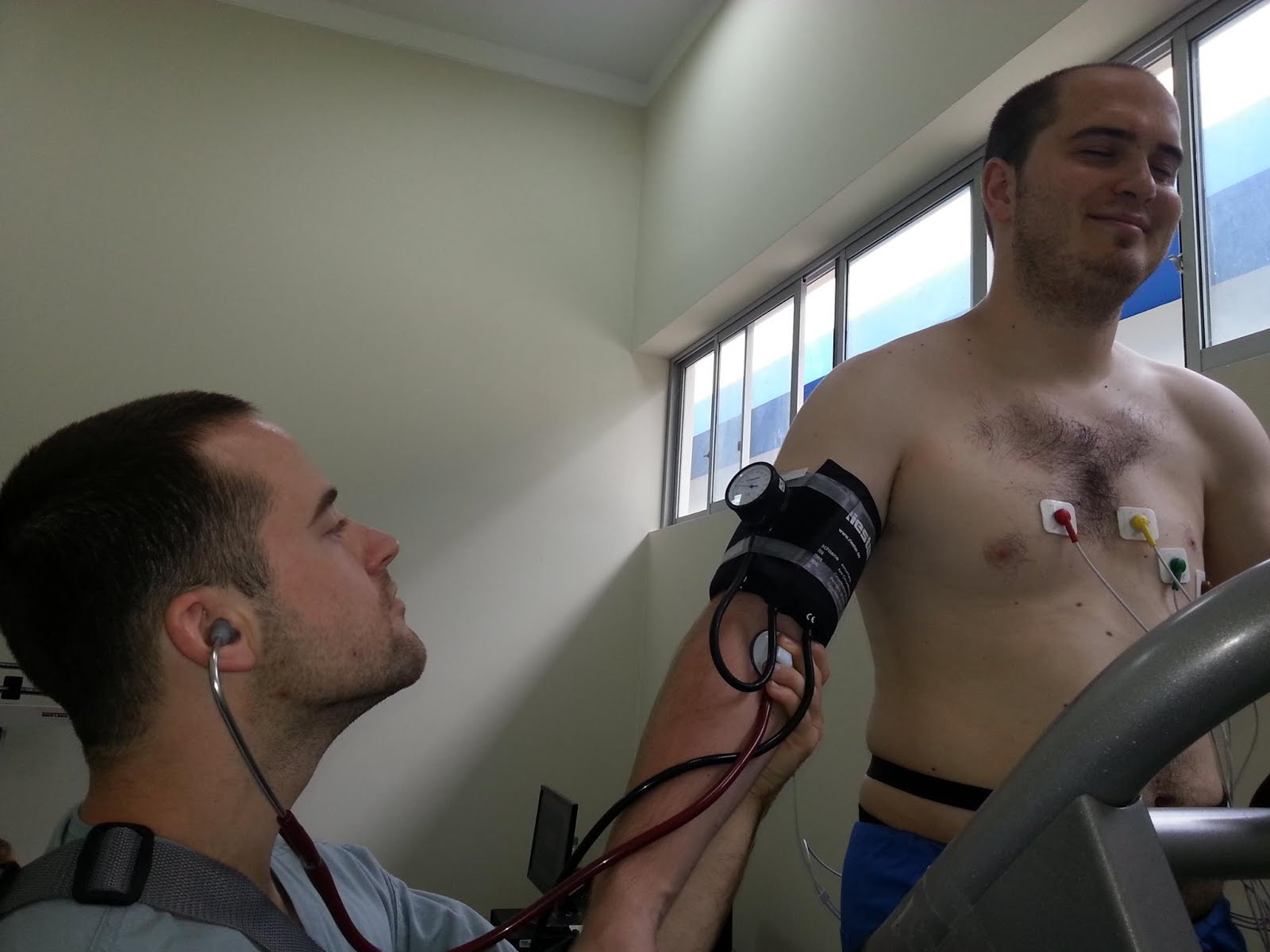
Props to Joe: taking a BP on somebody running on a treadmill is tough.  Oh, and yeah my stress test was normal.
          So what has this meant for my learning here in Peru?  For the time here to be a valuable addition to my clinical training, I needed to be challenged in a way similar to domestic clerkships that test my clinical skills and clinical knowledge.  Despite taking a far more conservative than normal approach to clinical training here in Peru, I still think these learning goals have satisfactorily been met.  On the one hand, a large part of my interest in doing a Global Health experience was the possibility to greatly improve my clinical communication abilities with Spanish-speaking patients.  This certainly has been the case, as working directly alongside doctors and patients who don’t speak a word of English has forced me to get better very quickly.  Additionally, I’ve learned a lot from analysing both the direct medical decision making as well as the greater healthcare system as a whole in Peru and comparing it to what I know at home.  Both the similarities and differences are illuminating, and I think I’m gaining some great perspective with every comparison of what seems to work and what doesn’t.  And finally, it’s been interesting to see many presentations of diseases that are rare but important in the U.S., like TB or stomach cancer.  So, though I might not be putting in central lines or evaluating multiple critical patients on my own before staffing them with a preceptor, I feel that the clinical experience has been well worth it and a strong addition to my final year before residency.

Saturday, February 13

Health Issues in Peru

After volunteering with different projects in Peru for 5 weeks and having the chance to work with doctors and nurses from La Merced and Huancayo, we have learned much about the challenges facing the Peruvian health system.  While our focus is more on teaching children about healthy habits and addressing nutrition issues, it has been very eye-opening to sit down with local doctors and discuss the issues they are facing and the different and similar issues that we face in the US.

Health Insurance - Most people in Peru are covered by public health insurance called SIS (Seguro Integral de Salud) that is available to all citizens.  It covers most of the basic things that health insurances cover, but there are some failings.  One major charge to patients is payment for supplies.  This may include basic things, like nutritional drinks (e.g., Ensure) for patients who can't eat solid foods and water to mix medications.  Families must go out and buy these supplies with their own money and give them to the hospital so they can be used to treat patients.  In rural areas, there is also the issue of transportation to larger hospitals.  One boy came into the health post after his hand was crushed by a machine in an iron-works facility.  One finger clearly had a fractured bone but the adult who brought him in insisted he be treated at the health post since the hospital was 30 minutes away and would cost about S/. 5 (quite a lot when weekly wages can be as low as S/. 30).  So the doctor did her best in a situation where there were no capabilities of getting an x-ray nor an available surgeon to treat the wound.  All she could do was suture the wound, place a splint, and ask him again to go to a hospital to get properly treated.

Health Posts - Most communities have a small health post which is similar to a community clinic in the US.  People come for routine well-child checks and urgent care type visits.  These health posts, however, are extremely under-resourced.  At one that I worked at, gloves were rationed to the point that they were only allowed for births and suturing and left over sutures were sterilized and re-used.  These health posts are also typically run by a recent medical school graduate.  All medical students are required to do a rural medicine year after graduating medical school and prior to starting residency.  These doctors are fresh out of medical school and are not overseen by a senior physician and are expected to handle the vast majority of cases that come through the door on their own.


Pharmacies - While most people in the US tend to head for an urgent care center or an emergency room when a cold or a pain comes up, the people of Peru often head first to a pharmacy.  Pharmacies are on ever corner and some offer medical consults for S/. 10 (or about $3 USD).  Often times, patients will come away with some pill which they take once and hope it works.  Patients rarely know what it is that they have taken and even when it is the right medication, they can only receive one days worth without a doctor's prescription, a dangerous thing when it comes to antibiotics and even more so when it is happening in a country where TB is prevalent and there are many cases of MDR and XDR-TB.

Traditional Healers - Traditional medicine is a very important aspect of Peruvian culture.  Traditional medicine practitioners are called curanderos.  One of their ways of detecting disease in people is by passing a guinea pig over the person's body and then performing a necropsy on the guinea pig to identify the disease.  There are also hueseros who are similar to chiropractors who focus on fixing pain through manipulating the bones.  Matronas are untrained midwives who help women deliver their babies at home, a very common practice.  Sometimes, these matronas provide women with an herbal drink to induce contractions, but these can sometimes induce placental rupture due to the strong contractions which tends to result in the death of the baby.

Obstetrics - Obstetricians face many challenges in Peru.  For one, pre-eclampsia and eclampsia are very common problems and deaths of pregnant women is a major public health concern.  For the obstetrician, however, there is added pressure as the death of the mother under their care can result in criminal prosecution.  Unsurprisingly, there are now very few obstetricians and women are having difficulty finding one when they need it.  Many women prefer to have their children at home, particularly in rural communities.  When they do, they often cut the umbilical cord using a rock or a roof shingle.  Abortions are illegal under Peruvian law and many women are at risk due to going to illegal abortion centers.  While contraceptive usage is fairly high nationally, the machismo culture sometimes forces women to say no to contraceptives since men feel that if their partner is using contraceptives, they would be more likely to cheat.

Pediatrics - Most of our focus has been with working with kids and being an aspiring Pediatrician, I had many opportunities to work with the Pediatric wards.  Many kids that we saw in the hospital were there due to accidents involving horses.  Broken legs, broken arms, and severe head injuries in several of our patients could be traced back to falling from a horse.  During our home assessments for our nutrition project, we also learned that safe sleep is not something that is done.  Parents almost always have their baby in their bed and none so far that we have met even own a crib, and very few babies sleep on their backs.

Other Diseases - Cancers, particularly stomach and cervical cancers, exist at relatively high rates in Peru.  Stomach cancers are likely linked to food preparations which often include very highly salted meats for preservation and fire-grilled foods.  Cervical cancer screening is increasing and more and more campaigns are being held to try and catch early cases.  Skin cancers are also common, particularly in Huancayo, where people live at high altitudes and there exists an ozone hole right over Peru.  People are also not very inclined to use sun protection.  Another disease that seemed more common in the rural areas was adermatografia, or the loss of fingerprints.  Some people who work in the farms or factories end up having their fingerprints erased due to constant manual labor.  These people must then get a medical certificate since fingerprints are used as an additional layer of identification on health forms and are required for a DNI, the national identification card that all citizens must have.

As you can probably tell, medical resources are severely limited in this country so I would like to thank all of you who have graciously donated supplies and/or finances to help us bring much needed items for the health care workers here in Peru.  Simple things like soap and toothpaste go a long way in helping kids stay healthy and a box of gloves can mean a greater sense of security for doctors when examining and treating patients.  We have seen these supplies go a long way in helping the people here have greater access to health.  Thank you for your generous support!

Tuesday, February 2

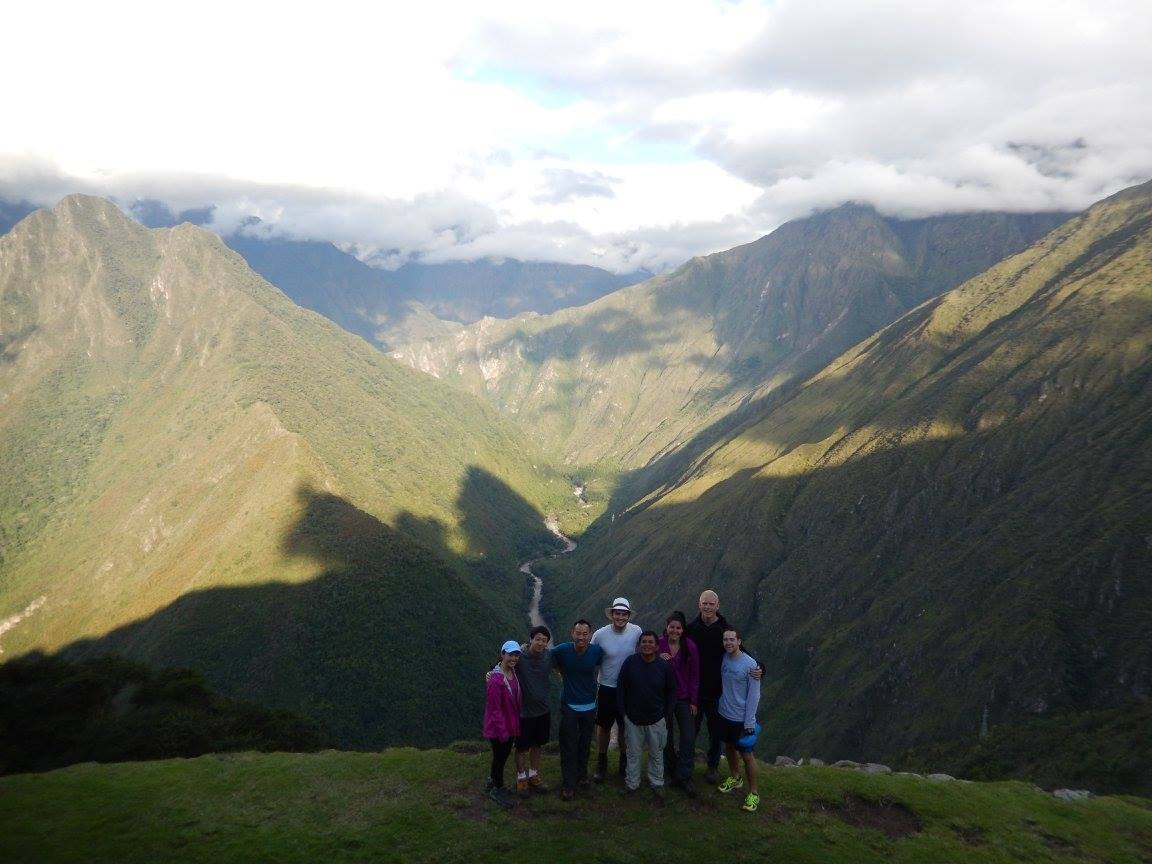
Incan Trail Hike & Machu Picchu

Day 1:  “Acclimatizing,” 5:45 AM wake up time

Day 1 of our hike on the Incan Trail with SAS Tours started with a 3 hour bus ride, with a breakfast break in between.  On the bus, we donned our sleeping bags and mats which weighed an additional 5 kg (11 lbs) on top of our own packed supplies. Elias was our guide through this journey to Machu Picchu and there were three other hikers that we met and started to get to know.  Our hike started at the train station at km 82 which sat at 2,680 meters.

Mey was not feeling well on this first day which made it difficult for her to carry on especially with her backpack.  Luckily, we did not ascend many meters on Day 1.  It was mostly for us to acclimate to the altitude.  We did not see many sites or points of interest, except for the beautiful mountain ranges and glacial peaks.

We did see a plant called a Tuna Cactus.  It has small blebs of fruit that grew off the main stalk.  We had a chance to try these at one of our rest stops.  It tasted a lot like watermelon but with less “fruit” part and a lot more “seed” part.  Nonetheless, it was refreshing.  The plant also produces small seeds that can be used to make rich paint colors.  The natural color is dark red, but when added to things like lime juice or salt, the colors change.  There apparently are around 25 colors that can be produced.  Joe wants to steal one of the leaves to be used for painting in his retirement.  

As for other plants, we learned about the “Angel’s Trumpet” which had hallucinogenic properties, the red more than the white.  There were apparently many other hallucinogenic plants that were used along with the Coca leaf to create a more direct spiritual connection with the Incan gods.  We also had a long history lesson by Elias explaining how many routes there were to Machu Picchu and how much of an interconnected web of trails the Incans constructed.

There were 10 porters for the 7 of us who each carried approximately 35 kg of supplies on their backs.  They hiked ahead of us at an alarming pace compared to us.  By the time we got to our lunch site, they had already set up tents and began preparing the meal.  We were all very impressed and surprised with how gourmet the food was.  For example, this day we had ceviche for an appetizer and many dishes for the main course.  They always served tea, coffee, water or hot chocolate.

After lunch, the porters would pack everything up and hike to the campsite for the night.  By the time we arrived, five tents for sleeping and one tent for dining were already erected.  Bathrooms were scattered throughout the trail but were usually a dirty hole in the ground where one would have to squat.  Toilet paper was usually not provided.  Public restrooms usually cost one sol.


Day 2:  “The Challenge,” 5:30 AM wake up time

Mey was still not feeling well on Day 2, and unfortunately this was the toughest day of our trek.  Mey decided to hire a porter to carry 9 kg of her materials.  According to her, “best investment EVER!”  We stumbled upon a scale which gave us a chance to weigh our bags.  Johnathan had 11.1 kg, Joe 11.6 kg, Nick, 13.0 kg, and Mey did not weigh hers.  However, just lifting her bag made it clear that it was one of the heaviest.  Thankfully, she was able to subtract the 9 kg for the rest of the trip.

We met an older man on the earlier part of the trail who spent his time picking up trash left by disrespectful hikers.  John, one of the other hikers, and Joe offered him some Coca chocolate which he graciously accepted.  We made it a point to keep our trash in our bags for disposal at the campsites, and even John and Joe picked up trash along the way as they came across it.

The weather was sunny and dry, perfect conditions for a light hike.  However, fog began rolling in just when the hike started to become more intense.  We reached a part of the trek called “Dead Woman’s Pass” because they found mummies there and the mountain range looks like a woman lying on her side with her arms crossed.  This was a steep climb to the summit of the mountain.  Beginning the day around 2,600 meters, we reached the summit out of breath at nearly 4,200 meters.  Unfortunately, the fog was so dense that it was difficult to make out any views at the peak.  It even rained a little.  We rested for a while to wait out the fog and were able to see a bit more of the distant views.  We took a number of photos here and also had a celebration with canned, first-catch, smoked salmon brought by our new hiking companion, Bobby.  He is a fisherman back in Alaska.


Shortly thereafter, we began the sharp, steep descent to our campsite.  The steps were nearly 1.5 feet deep and seemed endless.  We really worked our eccentric exercises and tore up our quads.  Eventually we arrived to our campsite after about 1.5 hours, located at the bottom of a large waterfall.

Over dinner, Nick began feeling feverish and nauseous.  He decided to retire early to bed and hopefully rest it off.  Mey did also as she was still not feeling 100%.  The rest of us shared a bottle of liquor provided by Elias after dinner.  We toasted to finishing the hardest day of our trek.  Johnathan toasted with a cup of water.  After leaving the tent, we were struck by a vividly clear night sky full of twinkling stars.  We stared in awe at the clarity of all the constellations.  What an enchanting feelings to sleep under such beauty.


Day 3:  “Cultural and Unforgettable,” 5:00 AM wake up time

With Mey and Nick already feeling under-the-weather, it was only a matter of time for another member of our group to fall ill.  Joe woke up at around 4:00 AM with intense nausea, vomiting and diarrhea.  He tried to take Azithromycin antibiotic but was unable to keep it down.  We soon after, began our hike with a steep ascent.  Joe was lagging far behind feeling as if he were going to get sick after every few steps.  Eventually he did and felt somewhat better, but for the rest of the day, felt borderline nauseous and weak.  He slept at every resting point.


Throughout the day, we came across four separate ruin sites.  The first was named Runquracay at 3,800 meters.  Here, we talked about the “quipu,” a knot system used to communicate by runners (chasquis) traveling between cities.

On this day's trek, we passed through a number of high jungles.  We noted that as we ascended/descended to various altitudes, the foliage changed.


The next ruin, Sayacmarka, was atop a set of high stairs off the path.  Here we learned about the Incan fountains and rain drainage systems which kept the cities from sinking.  The ruin was a temple used for animal sacrifices, specifically llamas.


The third ruin, Phuyupatamarka, was an angled terrace structure.  Here we discussed the importance of the three “Pachas” (Worlds): (1) Hanaq Pacha (“World Above” aka “Heaven”), (2) Kay Pacha (“This World”), and (3) Ukhu Pachu (“World Below”), symbolized by the condor, puma and the snake, respectively.  Incans believed that there was a continuum between these “worlds.”


The last ruin, Wiñaywayna, was a beautiful terrace structure on the side of a mountain face at 2,700 meters.  Here, we marveled at the view, traced the course of the journey by looking across the valley at the trail, and observed llamas grazing.  After a long three days or rigorous cardio, we enjoyed this final ruin before making our way to the final campsite thirty minutes away.


Day 4:  “Magical and Mystical,” 3:30 AM wake up time

We woke up very early in order to get in line for the Inti Punku, “The Sun Gate,” which is the entryway to Machu Picchu.  Even though, we joined the line at around 4:30 AM after packing up and finishing breakfast, we were still the last group in line.  Fortunately, we were able to rid of our sleeping bags and mats since it was our last day.  Surprisingly, 5 kg off our backs made it much easier to hike.  With this lighter load, we were able to pass by a number of groups on the trail to Machu Picchu.  It began raining approximately 1.5 hours in, and most of us were so determined to get there as soon as possible that we were pretty wet before putting on our ponchos.

Just before reaching Inti Punku, we came across a steep “staircase” that was coincidentally coined “Gringo Killer.”  The steps were nearly two feet tall and slippery due to the concurrent rain.  We saw a number of fellow hikers literally crawling up the stairs, but we made it up unscathed (mostly).

As we reached the Sun Gate at 2,750 meters, the clouds had completely engulfed our view of Machu Picchu and the surrounding mountains.  We continued to hike on while we waited for the rain to pass.  Upon reaching Machu Picchu at 2,400 meters, it was still raining heavily and the view was obscured.  We found the entrance to Machu Picchu where hiking averse enthusiasts would enter via the train.  Here we deposited our backpacks in lockers and attempted to dry off.  The rain still did not let up, and thus we began our tour of the site.  We were freezing and tried our best to listen to Elias describe this ancient architectural exhibit.

Five of us bought an extra ticket to climb a nearby mountain, Huanyapicchu, which overlooked Machu Picchu.  Of note, Machu Picchu literally means “Old Mountain” in the Incan language Quechua whereas Huanyapicchu means “Young Mountain.”  Fortunately the rain had begun to slow as we entered the Huanyapicchu trail.  It turned out that this trek was more rigorous than any of the other trails we had faced thus far, unbeknownst to us.  There were wire ropes that helped us climb at certain points, but otherwise, it was a straight drop down to the valley, hundreds of meters below.  The clouds began to dissipate before we had to descend the mountain, giving us picture-perfect views and photo opportunities to capture Machu Picchu.  We thought the ascent was bad, but the return trip was even more terrifying.

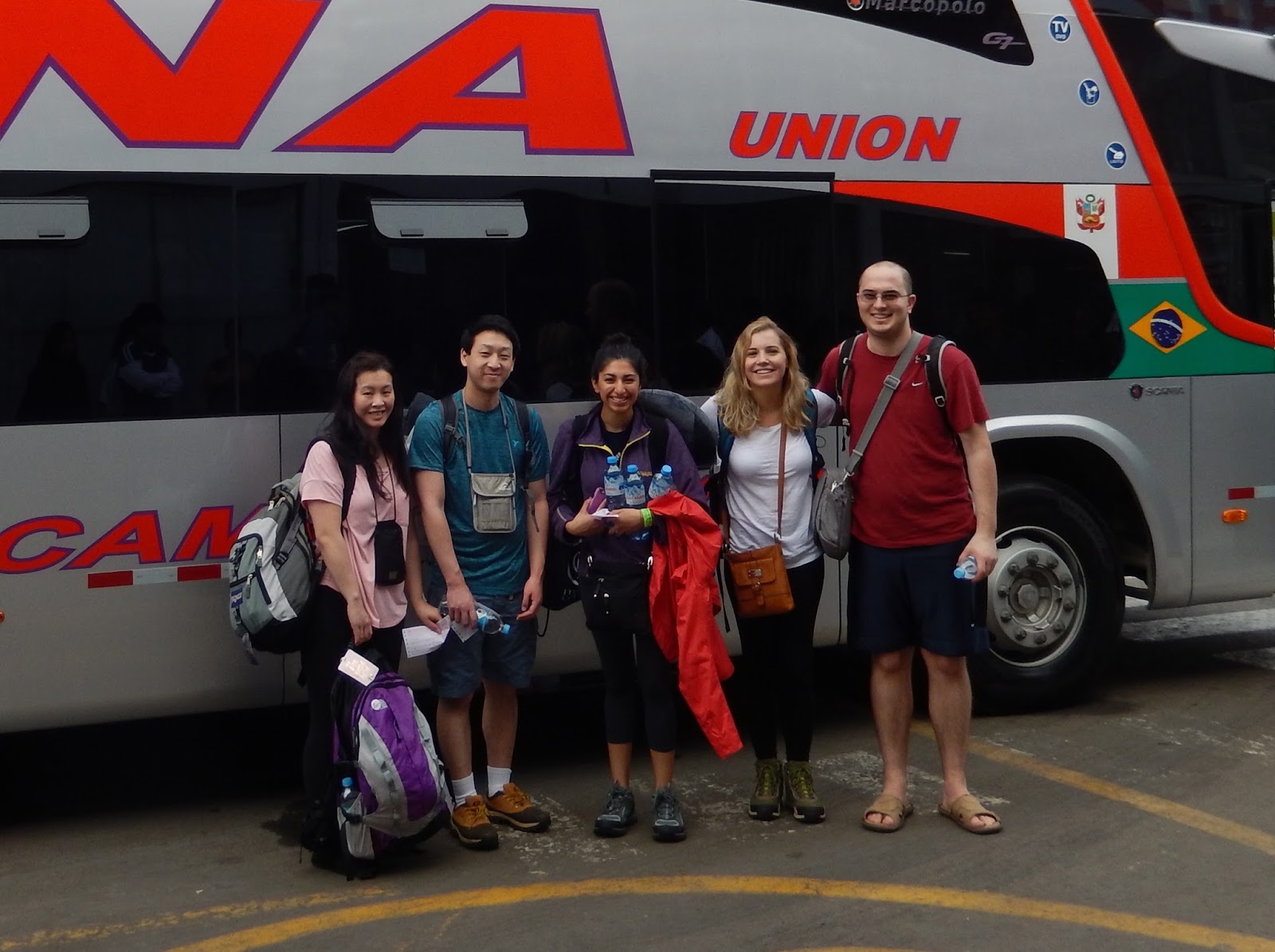
Around 1:30 PM, we grabbed our bags from the lockers and hopped a bus to Aguas Calientes, a nearby town that flourished due to local tourism.  Here, we enjoyed our last lunch together and boarded the PeruRail toward Ollantaytambo.  From there we took a SAS Travel bus back to Cuzco where we arrived around 8:30 PM.

In all, we walked over 50 km in four days with around 25 lbs on our back and up and down between 2,400 to 4,200 meters.  What a trek, eh!?  A great sense of accomplishment!
Sunday, January 24

Tragedies on buses and Training for bomberos

As we depart La Merced for the next phase of our journey, I wanted to post about a particular experience that meant a lot to me.  For my primary outreach project I have been working with FIMRC Peru to develop a series of "Emergency Preparedness" didactics for their partner communities, with the goal being for me to train one of their staff to head up the project for sustainability into the future.  Like I mentioned previously, the first lesson FIMRC requested was to teach CPR to laypeople in rural native communities, which I had some ethical dilemmas in doing.  The compromise I made was to teach the CPR lesson I designed to first responders in the city, which for La Merced is basically just the volunteer firefighters ("Los Bomberos").
And then, something tragic happened - a couple days before the lesson a bus crashed just outside the city.  The driver reportedly passed a car on a two-lane road only to be confronted with a potential head-on collision as he turned onto a bridge.  Rather than swerve back into his own lane, the driver did the unthinkable - he jumped out of the door onto the road, leaving the bus to drift sharply to the left, through the bridge's guardrail, and into the river below.  14 people died, and many more were critically injured.  The bomberos responded to the scene but many would later relate to us that they felt unprepared.

And so, two nights later we came to their firehouse to teach CPR.  I was worried it would be too basic for them. Quickly, though, we found that many basic skills were unpolished or unlearned.  I had them demonstrate taking a pulse, and many reached for the ulnar side of the wrist, or lateral to the SCM in the neck, or somewhere else that wasn't likely to elicit a pulse even in a healthy person.  I was happy that we could identify such a basic deficiency and provide an effective learning intervention.  So it was too with the CPR - many did not perform fast enough compressions, or deep enough compressions, or even more importantly, did not know the indications for CPR.


It was gratifying to be able to teach this lesson.  More importantly, the FIMRC staff member I've been mentoring for my project took well to the lesson and really seems primed to continue teaching this and other lessons we design going forward.  The biggest goal for me in global health projects like this is to achieve self-sustainability of any intervention I design, and I think this was a great start toward that end.
At the end, the fire-chief thanked us and related that she wished we had only been able to come a few days earlier, before the tragic bus accident.  Hopefully implementing this program will be a small step towards making sure that the next time tragedy strikes, they'll be that much better prepared in their response.


UPDATE 1/30/16: Dinah (FIMRC Field Operations Manager, in navy blue t-shirt above) has informed me that in the past week Alvaro (the FIMRC-Peru staff member I'm training for their "Emergency Preparedness"project, in red above) has independently taught the CPR lesson in addition to a Wound Care lesson I prepared and taught with him last Friday.  It's only one repetition and just a start towards sustainability, but this made me so happy :)

-Nick

Tuesday, January 19

Early week 2 update

What a great weekend.  Waterfalls, hiking, swimming in rivers.....it was some good R&R before starting a very busy week 2.
Velo de Novia, one of the waterfalls we visited


But now....back to work.  Yesterday was a longer day, working at the hospital in the morning before spending the afternoon and evening at the Chanchamayo prison for a health campaign.  We identified some sicker people there then at the health campaigns last week. Some examples included: out-of-control diabetes and hypertension, bloody cough and fevers concerning for tuberculosis, an unidentified neck mass concerning for a thyroid nodule, and a woman with stage III uterine cancer who recently developed rectal bleeding.  Interestingly, the accounts given by the prisoners sometimes did not match up with those of the prison's medical staff, who tended to downplay the concerns of the prisoners.  I'll leave that open to interpretation.  

This morning more work in the hospital, this time in cardiology. Tonight, we're going to the fire-station where I'll be leading some CPR teaching.  The firefighters are, from what I have been able to gather, the only medically equipped first-responders here in La Merced.  Unfortunately, they're all volunteers and many don't know how to use their equipment or perform basic life support procedures like CPR.  

There's some interesting and controversial ethics behind teaching CPR in developing countries, as highlighted in this paper by Friesen, Patterson, and Munjal from the past year.  I have some misgivings about designing CPR lessons for lay-people in rural native communities, which I had been asked to do originally by the FIMRC-Peru administration.  Without getting into it too much here, though, I see less of an ethical dilemma in teaching CPR to designated first-responders who are going to be taking ambulances to medical emergencies with or without me.  So I'm excited for tonight.

Hasta luego,
Nick

Thursday, January 14

Catching up with the last few days

First off, internet here in La Merced is extremely spotty so this is the first time I've been able to get online since Monday.  We've been busy, though, so there's a lot to catch up on.  The highlights:

Tuesday - We worked with a local women's organization in a couple different communities.  Part of the visits were general health campaigns, with the pre-med volunteers taking vitals, Accuchecks, BMI, etc., followed by the three of us looking over the results and offering what basic health counseling we could.  The other part focused on domestic violence, which is a big problem in Peru.  This included a segment where me and one of the other volunteers acted out a domestic violence skit, which Mey took a video of and is now holding me hostage with (Just kidding Mey! But seriously delete that video).


Wednesday - Trauma service.  Wound care is a bit different here, though perhaps in predictable ways. All wounds get copious amounts of iodine and alcohol, regardless of perceived contamination.  The reasoning is that they consider all wounds to be contaminated, at least at this hospital.  Related: there is not a lot of hand-washing.  Interesting case of the day: tense, swollen, dusky tissue surrounding a snake bite on a child's ankle.  DDx: Local necrosis primary to the snake bite versus evolving compartment syndrome.


Thursday - We went to a small native community called Belen, where we are helping them build a small school building for their kids.   This is one of two communities where FIMRC will be implementing the Emergency Preparedness program they asked me to help develop, so I was very excited to meet everyone today. Anyway, our day today consisted of climbing an hour up a mountain into the jungle, chopping down 5 trees, dragging them back down, and putting up the frame of the building:


We'll be back to finish the building next week, and we'll likely do our first Emergency Preparedness session as well.  Tomorrow it's off to another native community (the other one my project is going to hopefully be deployed in), where we'll be doing hand-washing teaching among other things.

Also excited for this weekend, when we'll take a little time for ourselves to go hike a waterfall in the nearby jungle.

Hasta Luego,

Nick

Monday, January 11

LMU Peru 2016: Primeras Impresiones


Nick: It was great to back in the emergency department for the first time in a few months, but this time it was in Peru!  The department wasn't all that different from what we see in the united states, but certain things did stand out.  It's mostly staffed by non-emergency trained physicians, similar to the original U.S. ED's or some contemporary rural ED's that haven't been able to hire emergency physicians.  The doctor I worked with today had excellent clinical acumen, and it was clear they rely a bit less on testing and radiology than we do.  It was a good shift, and I learned a lot.  I'm excited to go back, keep practicing my medical Spanish, and build relationships with the doctors in the ED.

In the afternoon we planned out our outreach activities for the rest of the week, some of which we'll be working on tomorrow.  It's shaping up to be a good week!

Johnathan: Our trip started off a little rough, with my donation baggage getting lost somewhere between Miami and Lima.  But I knew it would be a fun trip when in the first hour of our arrival, I was able to use my English, Spanish, and Chinese.  We spent our first day on travel and getting to know some of our teammates from Massachusetts and New York and then began our clinical experiences today.  Along the way, I got to try my first Peruvian street dish, choclo con queso (corn with the largest kernels ever and a side of cheese).  Today was our first clinical day and I got a taste of their internal medicine outpatient work with one of the most popular and hilarious doctors in the hospital.  Our hosts here in Peru have been amazing as well.  The host family made a great dinner of Peruvian tortillas (a kind of chicken omelette) and the staff, Dinah and Allison, have been incredibly helpful.  All in all, not a bad start.

Mey: I have been looking forward to this trip and it has not disappointed. On the plane, I sat next to a Peruvian lady who had married a Chinese man and was excited to meet a Chinese girl going to Peru. Even though my Spanish was limited, we had a great conversation and she offered to take us around Chinatown in Lima. So far the people have been amazing in Peru. The driver's wife knew Cantonese and I was so happy to chat with her. We spent the next day traveling from Lima to La Merced. The back drop of the Andes was breath taking. The massive rolling hills, waterfalls and winding roads was worth the long ride. Today was our first clinical experience here. I got to go to San Ramon, the next town over, and volunteered in the maternal/child department. What could be better than working with moms and their babies? Oh, and the coffee here is YUMMY.

Joe: The residency interview season caused me to arrive a little later than the rest of the group to Peru.  Unfortunately, this caused me to miss a few days of activities and to travel alone on the two day journey to La Merced.  It was definitely an experience traveling all the way from Michigan at 7:00 AM to Lima by 10:00 PM, making it all the way through customs and to the Hostel by 12:00 midnight, and riding on the 10 hour bus trip from Lima at 8:30 AM to La Merced where we arrived at 6:30 PM. Que una viaje larga!  I was on the second level of the bus and had a FANTASTIC view of the rolling, serpent-like roads that clung close to the mountainsides.  Often the road followed the natural tributaries of the Amazon river that carved out valleys in the mountains.  On first impression, the people of Peru are very kind, helpful and interested.  The city of Lima was a bit rough, but just outside it the Peruvian countryside is breathtaking.  I cannot believe how crazy the drivers are here.  Although I have experienced the insane driving of Haiti and other countries, in Peru it is a completely different ballgame because one poor move and you might find yourself rolling down the slope or crashing into the mountain side.  I look forward to investigating and learning more about this beautiful country. Stay tuned!