OVERVIEW

Thank you so much for taking time to look at our blog! We are a group of medical students who are passionate about training in underserved areas. This January and February, we are in Peru, Uganda, India, and Costa Rica internationally as well as locally in Flint and Lansing completing volunteer service, rotating in hospitals and clinics, and learning about international medicine and local underserved health care. We appreciate any time you take to read our reflections and any donations you might offer.

Please click the “Donate” link on the side for more details on how to give directly to these communities.


Thursday, February 4

#treschicasenrica

Hello Again Family, Friends, and Supporters!


This post has been long overdue, but we have been keeping so busy and things haven't quite slowed down enough for a post!  So let me update you on what we have been up to!


Penny Papanicolaou:  Last Wednesday we had another 'charla' or health education session with the women at the soup kitchen.  We took this opportunity to talk to the women about women's health and more specifically, Papanicolaou…or as we say the The States…a Pap smear.  For starters, in Spanish the test is called "Papanicolaou" because that is actually it's full name…in The States we just use abbreviations.  Georgios Nikolaou Papanikolaou was a Greek cytopathologists who studied early cancer detection and invented the test which later was called a Pap Smear in the English language.  I was so happy to prepare this lecture with my two colleagues (Amanda and Huda) who are budding OBGYNS…they were awesome!  The women were SO interested in this topic.  I know we gave them lots of great information and knowledge that will help empower them to take ownership of their health and enable them to take better care of themselves.  For those of you who don't know, Papanicolaou (which I still cannot spell) is an ESSENTIAL screening in the prevention of cervical cancer.  In today's day, having Papanicolaou is arguably even more important because of the prevalence of Human Papilloma Virus (HPV) and its innate ability to predispose women to cell dysplasia dn ultimately cervical cancer.  The group of women we provide health education to are among the highest risk populations. These women are at higher risk because they are a part of a medically underserved group of individuals who do not have insurance.  During this talk we provided them with information for receiving Papanicolaou at a reduced cost of 11,000 colones (about 20 American dollars).  This week, we gave a great charla about two topics: 1) Smoking and its Effects and 2) the Zika Virus.  These topics were also very well received by the attendees.  Unfortuatnely, we do have any pictures from this week's charla, but below you can see pictures from last week.


Pictured: (upper left) Amanda, Andrea, Penny Papanicolau (diagram) Huda (upper right) Amanda, Andrea, play-dough uterus, and Doctora Karen (lower left) attendees of the charla (lower right) Amanda, Andrea, cervical brush.


Below: Pictures from random days in the clinic; (left) Dr. Schnuth with two patients that fell in love with her and did not want to leave the clinic until we bribed them with stickers ;) (center) Huda, Dayan (clinic coordinator), Andrea, Doctora Karen, Amanda enjoying an afternoon popsicle in the exam room (right) #treschicasenrica taking a mid-workday selfie


Birthdays: We also have celebrated a few Birthdays in the clinic recently.  Below are some pictures from Danielito's 8th Birthday!  Daniel is the son of our FIMRC Clinic's beloved housekeeper Socoru.  He wanted nothing more than to have his birthday party at the clinic with us.  Although the children look unhappy in the bottom photo-- I assure you they were very happy-- and may have been in a sugar induced coma at that point!  Attendees were encouraged to have cake (the most amazing carmel/carrot? cake ever), purple bubble gum ice cream with chocolate straws (to slurp up the melted ice cream of course), and a large glass (or two!) of Coca Cola (made from pure Sugar Cane).  Holy moly-- that was a culture shocking thing for me to see!  We had a wonderful time celebrating Daniel's birthday!


Weekend Excursion: Over the weekend we were able to take an amazing trip to Montezuma!  I will post more about our weekend trip at a later date (too many details to post).  However, pictured below is a panoramic view of Montezuma Beach (courtesy of Huda's photography skills).  It was a gorgeous weekend and an amazing experience. 


Projects: Since we last blogged we also have been presented with a slew of projects that we have been very excited to get started on!  We decided to take a divide and conquer approach among the three of us girls…so I'll break down the projects accordingly. 

1. Clinic Handbook and Volunteer Informational Guide [Huda]-- For this project Huda is developing a resource for FIMRC volunteers to preview before they make their trip to Alajuelita, Costa Rica. Huda is including extremely important information such as how the clinic runs, what the different jobs are for volunteers in the clinic, how to conduct those jobs, and different tips and tricks at how to be successful during their stay.  This guide will be and awesome tool to give the clinic when we leave.  Right now, all information and instruction falls on the clinic's coordinators who are very busy coordinating patient care (amongst their many other roles).  This guide will help volunteers be self-instructed and prepared upon their arrival to jump right in and become a member of the existing team.

2. Clinic Calendar and Charla Schedule Development [Andrea]: As of right now, the clinic organizes about 1 charla a week for women at the soup kitchen.  Upon until this time, we have been brainstorming weekly to decide what we should teach the women about each week.  While this is nice to stay abreast of current events in health, it is also time consuming and not the most efficient use of our clinic time.  Thus, I am creating a year long calendar for the clinic that is full with daily activities and is accessible by all clinic members-- employees, volunteers, and community members alike.  Part of this calendar development includes developing an health education theme for each month and coordinating the weekly charlas and activity with that theme.  For instance, February is "Addiction and Vices" month-- this month our charkas will include a Smoking Campaign (today), Alcohol and its Health Risks, Drugs and Gambling, and General Health and Hygiene (the Importance of Sleep, Diet, Exercise Etc.)

3. Intake and Screening Questionnaire Development and Translations [Amanda]: The clinic has very recently transitioned to an electronic medical record system, which we are still working the kinks out of. Amanda has taken over the job of developing intake and screening questionnaires for common diseases that we see in the clinic.  She is using templates to develop questionnaires that are personalized to FIMRC and our patient population.  This large task requires some translating back and for from English-Spanish and some designing of common measurement tools and graphs used in the medical field. Streamlining this system will help the clinic tremendously with organization and keeping track of patients with chronic diseases and needs. 

4. Pharmacy [All]:  Lastly, we are in preliminary discussions of how we can reorganize our pharmacy!  Below are some pictures of our humble pharmacy which is filled so wonderfully with your generous donations.  We have been working since our arrival on organizing and reorganizing the layout of the pharmacy so that it is easily accessible for workers to fill prescriptions and also organized in the most logical way.  This is a work in progress that we hope to update you more on in the next few weeks to come. 


We cannot believe we are already half way through with this amazing experience!  We don't like to think about that too much, for now we are trying to soak it all in…one experience at a time!  For now, Ciao from myself and my partners!

Andrea 
#treschicasenrica 


Tuesday, February 2

Incan Trail Hike & Machu Picchu

Day 1:  “Acclimatizing,” 5:45 AM wake up time

Day 1 of our hike on the Incan Trail with SAS Tours started with a 3 hour bus ride, with a breakfast break in between.  On the bus, we donned our sleeping bags and mats which weighed an additional 5 kg (11 lbs) on top of our own packed supplies. Elias was our guide through this journey to Machu Picchu and there were three other hikers that we met and started to get to know.  Our hike started at the train station at km 82 which sat at 2,680 meters.

Mey was not feeling well on this first day which made it difficult for her to carry on especially with her backpack.  Luckily, we did not ascend many meters on Day 1.  It was mostly for us to acclimate to the altitude.  We did not see many sites or points of interest, except for the beautiful mountain ranges and glacial peaks.

We did see a plant called a Tuna Cactus.  It has small blebs of fruit that grew off the main stalk.  We had a chance to try these at one of our rest stops.  It tasted a lot like watermelon but with less “fruit” part and a lot more “seed” part.  Nonetheless, it was refreshing.  The plant also produces small seeds that can be used to make rich paint colors.  The natural color is dark red, but when added to things like lime juice or salt, the colors change.  There apparently are around 25 colors that can be produced.  Joe wants to steal one of the leaves to be used for painting in his retirement.  

As for other plants, we learned about the “Angel’s Trumpet” which had hallucinogenic properties, the red more than the white.  There were apparently many other hallucinogenic plants that were used along with the Coca leaf to create a more direct spiritual connection with the Incan gods.  We also had a long history lesson by Elias explaining how many routes there were to Machu Picchu and how much of an interconnected web of trails the Incans constructed.

There were 10 porters for the 7 of us who each carried approximately 35 kg of supplies on their backs.  They hiked ahead of us at an alarming pace compared to us.  By the time we got to our lunch site, they had already set up tents and began preparing the meal.  We were all very impressed and surprised with how gourmet the food was.  For example, this day we had ceviche for an appetizer and many dishes for the main course.  They always served tea, coffee, water or hot chocolate.

After lunch, the porters would pack everything up and hike to the campsite for the night.  By the time we arrived, five tents for sleeping and one tent for dining were already erected.  Bathrooms were scattered throughout the trail but were usually a dirty hole in the ground where one would have to squat.  Toilet paper was usually not provided.  Public restrooms usually cost one sol.


Day 2:  “The Challenge,” 5:30 AM wake up time

Mey was still not feeling well on Day 2, and unfortunately this was the toughest day of our trek.  Mey decided to hire a porter to carry 9 kg of her materials.  According to her, “best investment EVER!”  We stumbled upon a scale which gave us a chance to weigh our bags.  Johnathan had 11.1 kg, Joe 11.6 kg, Nick, 13.0 kg, and Mey did not weigh hers.  However, just lifting her bag made it clear that it was one of the heaviest.  Thankfully, she was able to subtract the 9 kg for the rest of the trip.

We met an older man on the earlier part of the trail who spent his time picking up trash left by disrespectful hikers.  John, one of the other hikers, and Joe offered him some Coca chocolate which he graciously accepted.  We made it a point to keep our trash in our bags for disposal at the campsites, and even John and Joe picked up trash along the way as they came across it.

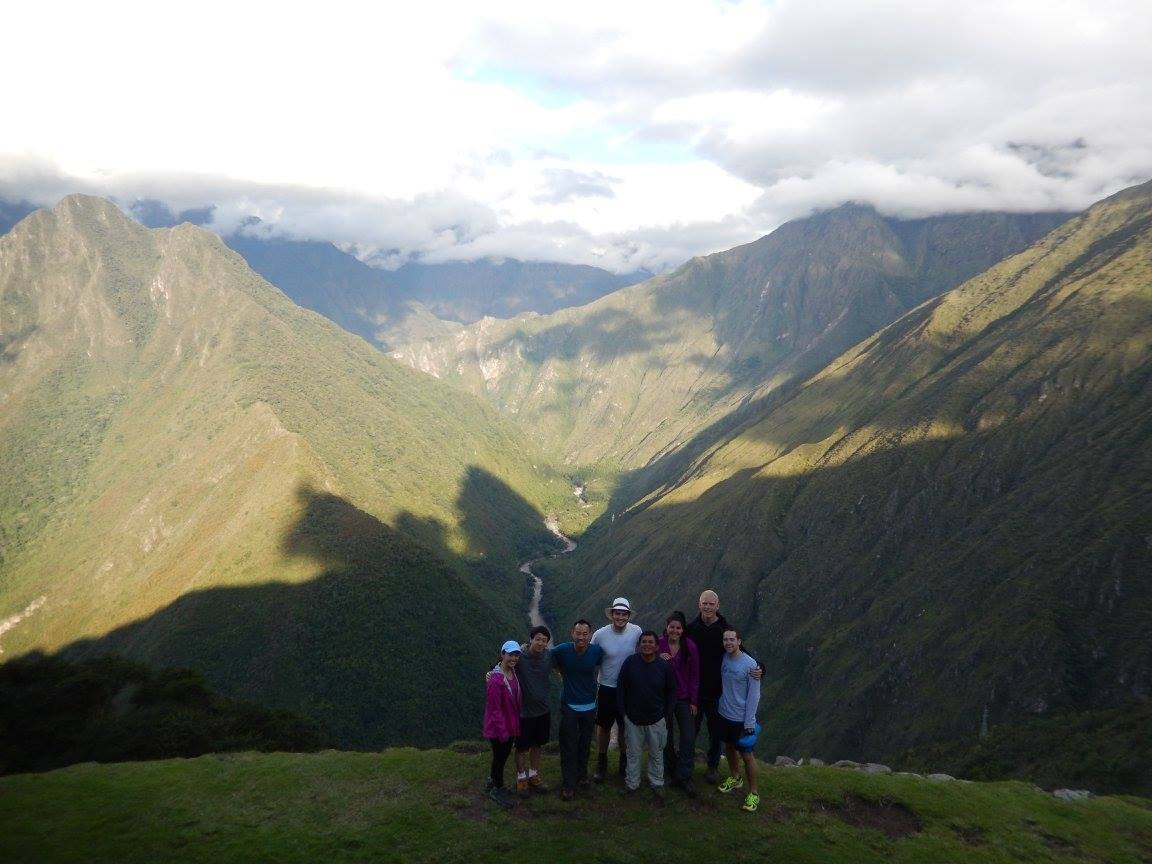
The weather was sunny and dry, perfect conditions for a light hike.  However, fog began rolling in just when the hike started to become more intense.  We reached a part of the trek called “Dead Woman’s Pass” because they found mummies there and the mountain range looks like a woman lying on her side with her arms crossed.  This was a steep climb to the summit of the mountain.  Beginning the day around 2,600 meters, we reached the summit out of breath at nearly 4,200 meters.  Unfortunately, the fog was so dense that it was difficult to make out any views at the peak.  It even rained a little.  We rested for a while to wait out the fog and were able to see a bit more of the distant views.  We took a number of photos here and also had a celebration with canned, first-catch, smoked salmon brought by our new hiking companion, Bobby.  He is a fisherman back in Alaska.


Shortly thereafter, we began the sharp, steep descent to our campsite.  The steps were nearly 1.5 feet deep and seemed endless.  We really worked our eccentric exercises and tore up our quads.  Eventually we arrived to our campsite after about 1.5 hours, located at the bottom of a large waterfall.

Over dinner, Nick began feeling feverish and nauseous.  He decided to retire early to bed and hopefully rest it off.  Mey did also as she was still not feeling 100%.  The rest of us shared a bottle of liquor provided by Elias after dinner.  We toasted to finishing the hardest day of our trek.  Johnathan toasted with a cup of water.  After leaving the tent, we were struck by a vividly clear night sky full of twinkling stars.  We stared in awe at the clarity of all the constellations.  What an enchanting feelings to sleep under such beauty.


Day 3:  “Cultural and Unforgettable,” 5:00 AM wake up time

With Mey and Nick already feeling under-the-weather, it was only a matter of time for another member of our group to fall ill.  Joe woke up at around 4:00 AM with intense nausea, vomiting and diarrhea.  He tried to take Azithromycin antibiotic but was unable to keep it down.  We soon after, began our hike with a steep ascent.  Joe was lagging far behind feeling as if he were going to get sick after every few steps.  Eventually he did and felt somewhat better, but for the rest of the day, felt borderline nauseous and weak.  He slept at every resting point.


Throughout the day, we came across four separate ruin sites.  The first was named Runquracay at 3,800 meters.  Here, we talked about the “quipu,” a knot system used to communicate by runners (chasquis) traveling between cities.

On this day's trek, we passed through a number of high jungles.  We noted that as we ascended/descended to various altitudes, the foliage changed.


The next ruin, Sayacmarka, was atop a set of high stairs off the path.  Here we learned about the Incan fountains and rain drainage systems which kept the cities from sinking.  The ruin was a temple used for animal sacrifices, specifically llamas.


The third ruin, Phuyupatamarka, was an angled terrace structure.  Here we discussed the importance of the three “Pachas” (Worlds): (1) Hanaq Pacha (“World Above” aka “Heaven”), (2) Kay Pacha (“This World”), and (3) Ukhu Pachu (“World Below”), symbolized by the condor, puma and the snake, respectively.  Incans believed that there was a continuum between these “worlds.”


The last ruin, Wiñaywayna, was a beautiful terrace structure on the side of a mountain face at 2,700 meters.  Here, we marveled at the view, traced the course of the journey by looking across the valley at the trail, and observed llamas grazing.  After a long three days or rigorous cardio, we enjoyed this final ruin before making our way to the final campsite thirty minutes away.


Day 4:  “Magical and Mystical,” 3:30 AM wake up time

We woke up very early in order to get in line for the Inti Punku, “The Sun Gate,” which is the entryway to Machu Picchu.  Even though, we joined the line at around 4:30 AM after packing up and finishing breakfast, we were still the last group in line.  Fortunately, we were able to rid of our sleeping bags and mats since it was our last day.  Surprisingly, 5 kg off our backs made it much easier to hike.  With this lighter load, we were able to pass by a number of groups on the trail to Machu Picchu.  It began raining approximately 1.5 hours in, and most of us were so determined to get there as soon as possible that we were pretty wet before putting on our ponchos.

Just before reaching Inti Punku, we came across a steep “staircase” that was coincidentally coined “Gringo Killer.”  The steps were nearly two feet tall and slippery due to the concurrent rain.  We saw a number of fellow hikers literally crawling up the stairs, but we made it up unscathed (mostly).

As we reached the Sun Gate at 2,750 meters, the clouds had completely engulfed our view of Machu Picchu and the surrounding mountains.  We continued to hike on while we waited for the rain to pass.  Upon reaching Machu Picchu at 2,400 meters, it was still raining heavily and the view was obscured.  We found the entrance to Machu Picchu where hiking averse enthusiasts would enter via the train.  Here we deposited our backpacks in lockers and attempted to dry off.  The rain still did not let up, and thus we began our tour of the site.  We were freezing and tried our best to listen to Elias describe this ancient architectural exhibit.

Five of us bought an extra ticket to climb a nearby mountain, Huanyapicchu, which overlooked Machu Picchu.  Of note, Machu Picchu literally means “Old Mountain” in the Incan language Quechua whereas Huanyapicchu means “Young Mountain.”  Fortunately the rain had begun to slow as we entered the Huanyapicchu trail.  It turned out that this trek was more rigorous than any of the other trails we had faced thus far, unbeknownst to us.  There were wire ropes that helped us climb at certain points, but otherwise, it was a straight drop down to the valley, hundreds of meters below.  The clouds began to dissipate before we had to descend the mountain, giving us picture-perfect views and photo opportunities to capture Machu Picchu.  We thought the ascent was bad, but the return trip was even more terrifying.

Around 1:30 PM, we grabbed our bags from the lockers and hopped a bus to Aguas Calientes, a nearby town that flourished due to local tourism.  Here, we enjoyed our last lunch together and boarded the PeruRail toward Ollantaytambo.  From there we took a SAS Travel bus back to Cuzco where we arrived around 8:30 PM.

In all, we walked over 50 km in four days with around 25 lbs on our back and up and down between 2,400 to 4,200 meters.  What a trek, eh!?  A great sense of accomplishment!

Thursday, January 28

Week two in the DR...


            On our day trip across the border to Haiti there were three patients with cholera.  They have their own small building known as the cholera ward. We were told that cholera is not that uncommon in the more remote areas, many of which lack latrines. A few days later we were surprised when a patient showed up at the hospital in Restauracioń with cholera.  The doctor has treated cholera patients before and made a clinical diagnosis, that was later confirmed by a laboratory a few days later. Fortunately, this patient was the only one we saw.  This presented an opportunity to go out to the community and educate about cholera.  We prepared scripts and we literally went door to door in selected neighborhoods.


            Dr. Ricardo also anticipated the need to educate and raise awareness about Zika virus, so a few days after the cholera education, we hit the streets again and spread the word about mosquito borne illnesses (dengue, chikyngunea, malaria, and zika). Much of the education was geared at eliminating mosquito breeding grounds, ie.) standing water.  I am happy to report that we finished this project before the CDC travel warning. All credit goes to Dr. Ricardo, he is amazing!


We do get to have a little fun too.  More on that later.


Sunday, January 24

Tragedies on buses and Training for bomberos

As we depart La Merced for the next phase of our journey, I wanted to post about a particular experience that meant a lot to me.  For my primary outreach project I have been working with FIMRC Peru to develop a series of "Emergency Preparedness" didactics for their partner communities, with the goal being for me to train one of their staff to head up the project for sustainability into the future.  Like I mentioned previously, the first lesson FIMRC requested was to teach CPR to laypeople in rural native communities, which I had some ethical dilemmas in doing.  The compromise I made was to teach the CPR lesson I designed to first responders in the city, which for La Merced is basically just the volunteer firefighters ("Los Bomberos").
And then, something tragic happened - a couple days before the lesson a bus crashed just outside the city.  The driver reportedly passed a car on a two-lane road only to be confronted with a potential head-on collision as he turned onto a bridge.  Rather than swerve back into his own lane, the driver did the unthinkable - he jumped out of the door onto the road, leaving the bus to drift sharply to the left, through the bridge's guardrail, and into the river below.  14 people died, and many more were critically injured.  The bomberos responded to the scene but many would later relate to us that they felt unprepared.

And so, two nights later we came to their firehouse to teach CPR.  I was worried it would be too basic for them. Quickly, though, we found that many basic skills were unpolished or unlearned.  I had them demonstrate taking a pulse, and many reached for the ulnar side of the wrist, or lateral to the SCM in the neck, or somewhere else that wasn't likely to elicit a pulse even in a healthy person.  I was happy that we could identify such a basic deficiency and provide an effective learning intervention.  So it was too with the CPR - many did not perform fast enough compressions, or deep enough compressions, or even more importantly, did not know the indications for CPR.


It was gratifying to be able to teach this lesson.  More importantly, the FIMRC staff member I've been mentoring for my project took well to the lesson and really seems primed to continue teaching this and other lessons we design going forward.  The biggest goal for me in global health projects like this is to achieve self-sustainability of any intervention I design, and I think this was a great start toward that end.
At the end, the fire-chief thanked us and related that she wished we had only been able to come a few days earlier, before the tragic bus accident.  Hopefully implementing this program will be a small step towards making sure that the next time tragedy strikes, they'll be that much better prepared in their response.


UPDATE 1/30/16: Dinah (FIMRC Field Operations Manager, in navy blue t-shirt above) has informed me that in the past week Alvaro (the FIMRC-Peru staff member I'm training for their "Emergency Preparedness"project, in red above) has independently taught the CPR lesson in addition to a Wound Care lesson I prepared and taught with him last Friday.  It's only one repetition and just a start towards sustainability, but this made me so happy :)

-Nick

Friday, January 22

Week 1 in DR and Haiti

Greetings from the Dominican Republic, where the coffee is strong and the music is always playing!
We're happy to say we arrived to Restauracion without any security issues or lost luggage.  Each of us were placed with a family within walking distance. It was a little bit of an adjustment not having internet or hot water, but overall we've felt very welcomed and almost at home here.  Here in Restauracion, FIMRC coordinates many activities here and in Haiti every week.  The mornings are usually divided between the hospital and the local clinic, except for the one day per week we go to Haiti.  The afternoon usually focuses on educational activities at a local school, library, or by going door to door to educate the locals.  In January we are focusing on HIV/AIDS education.
The view from the FIMRC office.

Living in Restauracion: Life here is very different from what we are used to in the US.  We have scheduled power outages every other day.  Running water tends to alternate with the electricity.  Oh, and we don't flush toilet paper! Every night there's music playing at various bars throughout the town. It is a bit humid here but none of us can complain when the temperature hovers around 80F.
Group discussion.

Visiting Haiti was a very touching experience- the living conditions there are extremely bad.  They still have cholera outbreaks. Their access to water and electricity is much more limited.  Most houses resemble shacks and have dirt floors.  Many Haitians try to escape poverty by crossing through the porous border into Dominican Republic only to face low wages, racism, extortion, and possible violence.


The group in Haiti.

Thursday, January 21

A Very Delayed Week 1!


¡Hola de Costa Rica! Amanda and Andrea did a wonderful job sharing some of our most meaningful activities during our first week.   Im going to try to give a close-up look at our clinic that we travel to in the city of Alajuelita.  During our first week we were able to get acquainted with our host families and the routine of the clinic. 


The main reception area where we check in patients.

Patient waiting area

 Our main volunteer area

Our roles for the day, where we get to alternate each day. WR= waiting room, EX R= Exam room, Pharm= Pharmacy, SK= Soup Kitchen

The clinic is integrated into the community of the small town of Alajuelita due to its high concentration of Nicaraguan immigrants.  The immigrant situation of Nicaraguans is interesting because they are considered "illegal" yet they are accepted to contribute to society through construction jobs, waste management and other jobs less likely to be in demand among Costa Ricans.  Despite their contribution to society, they are not able to purchase Costa Riccan social health insurance and therefore cannot obtain routine healthcare from various E.B.A.I.S. centers or Equipos Básicos de Atención Integral en Salud which serve as first-line health centers.

We see many women and children as well as teenage and adult males.  The doctor provides acute care for non-emergent cases as well as chronic disease management. The clinic helps with managing chronic conditions by giving them a starter regimen for their needed medications as well as plenty of patient education.

I really enjoyed being a part of a few child psychology sessions with the clinic Psychologist, Tatiana.  The conditions that are endured by families can cause young children to find unhealthy and dangerous coping strategies, and it gives me hope that starting regular sessions would improve their coping skills now as well as later during their adult years. 


Looking forward to meeting more people of Alajuelita and being a part of FIMRC's Proyecto Alajuelita!

-Huda